
Anderson County Bankruptcy Records
Anderson County bankruptcy records are filed and maintained through the U.S. Bankruptcy Court for the Eastern District of Tennessee, which handles all federal bankruptcy cases for Anderson County residents and businesses. Clinton serves as the county seat, and those seeking court documents can access them through PACER, by phone through VCIS, or in person at the Knoxville federal courthouse. This guide walks you through each access method and the local court resources available in Anderson County.
Anderson County Quick Facts
Anderson County and the Eastern District
Anderson County falls within the Eastern District of Tennessee, Knoxville Division. The federal courthouse that handles Anderson County bankruptcy filings is the Howard H. Baker Jr. U.S. Courthouse, located at 800 Market Street Suite 330, Knoxville TN 37902. You can reach the clerk's office by phone at (865) 545-4279. Office hours run Monday through Friday, 8:00 a.m. to 4:30 p.m.
The Eastern District court website is at https://www.tneb.uscourts.gov. That site has local rules, forms, filing guides, and information about the court's electronic filing system. If you need to visit the Knoxville courthouse in person, plan to arrive during business hours with a valid photo ID. Parking is available near Market Street in downtown Knoxville. The Baker courthouse serves a large number of East Tennessee counties, so the clerk's office can get busy, especially early in the week.
The Anderson County government website provides access to public records request forms and county services.
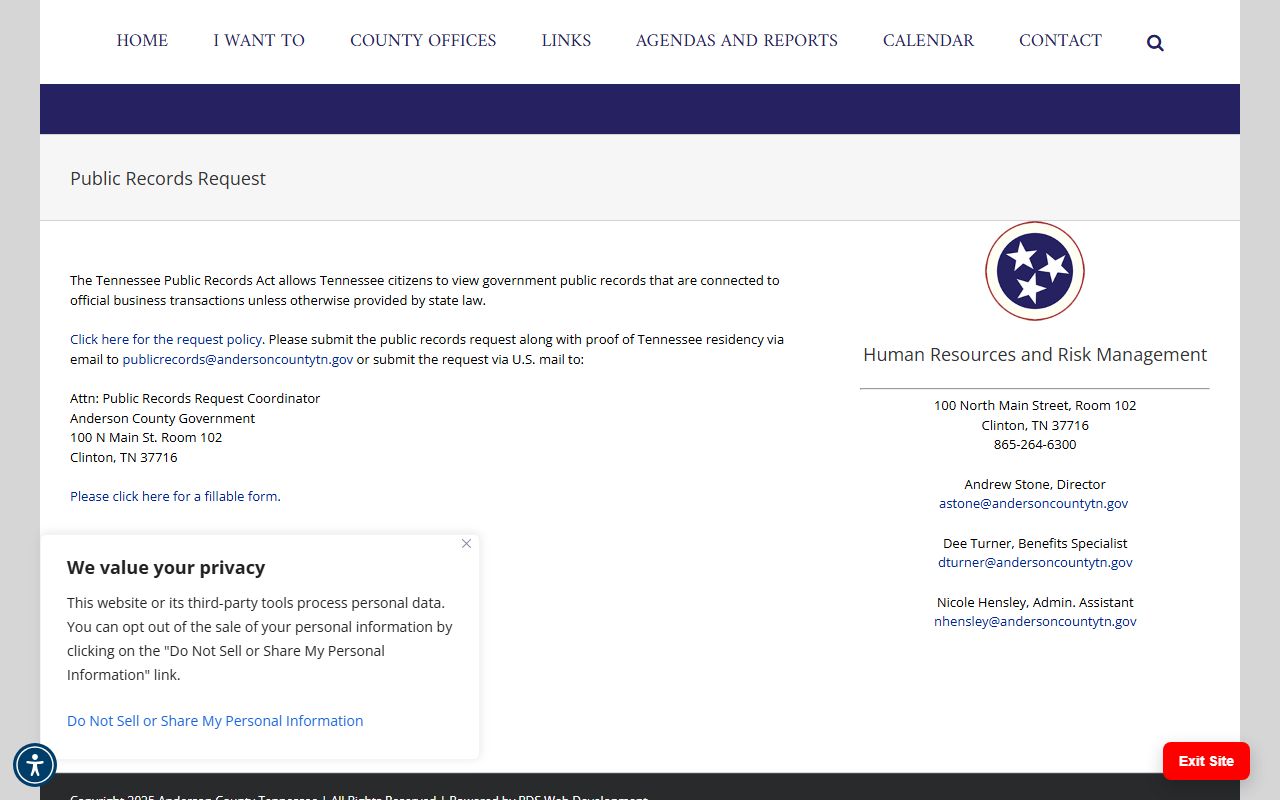
This portal lets residents request court documents and access Anderson County records online.
Searching Anderson County Bankruptcy Records
The main tool for searching Anderson County bankruptcy records is PACER, the federal courts' online case management system. You can access it at https://pacer.uscourts.gov. PACER charges 10 cents per page, with a maximum of $3.00 per document. If your total charges in a quarter stay under $30, the fees are waived. Most users who do light research end up paying nothing.
To search, log in to PACER and select the U.S. Bankruptcy Court for the Eastern District of Tennessee. You can search by debtor name, case number, Social Security number (last four digits), or attorney name. Results show the full docket, including all filings, hearing dates, and any orders entered by the court. The PACER Case Locator is a good starting point if you're not sure which district handled a case. It searches across all federal courts at once.
If you prefer a free option, the Voice Case Information System (VCIS) gives basic case status by phone. Call 866-222-8029 and press extension 813 for the Eastern District. VCIS works around the clock. You'll need the debtor's name or case number.
Anderson County state court records, including civil, criminal, and probate matters, can be searched through anderson.tncrtinfo.com. Note: that system covers state-level filings only, not federal bankruptcy cases.
The Anderson County Circuit Court docket search lets you look up local court case information and clerk records.
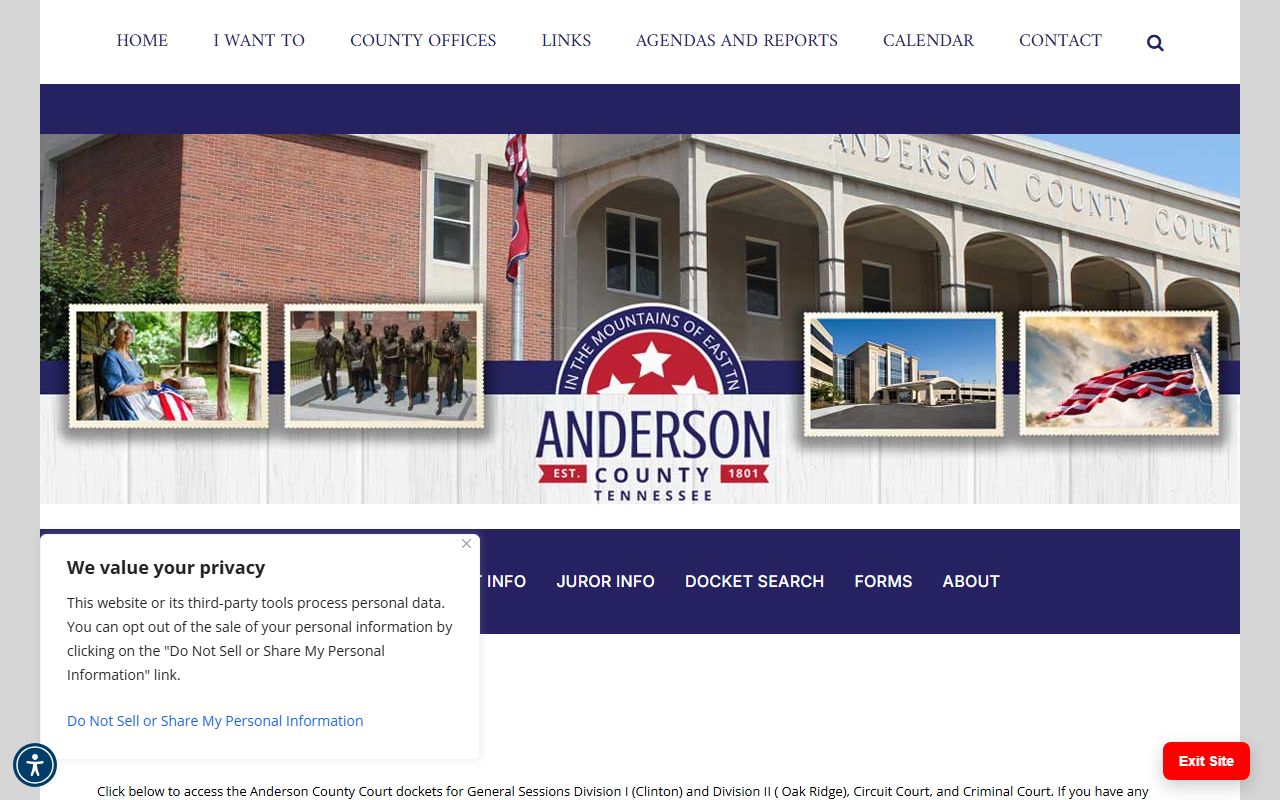
This docket search tool covers Anderson County state court filings, which may include related civil actions tied to bankruptcy proceedings.
Anderson County Court Resources
The Anderson County Circuit Court Clerk is located at 100 North Main Street, Room 244, Clinton TN 37716. You can reach that office at (865) 457-6224. The clerk handles state court filings, civil cases, and local records. Federal bankruptcy cases are filed in Knoxville, not Clinton, so the local clerk does not hold bankruptcy dockets. However, the Circuit Court Clerk can help with related state matters like civil judgments that sometimes accompany or follow a bankruptcy filing.
For county-level information, the Anderson County government website at andersoncountytn.gov covers departments, public records requests, and contact details for local offices. The public records request page is the right place to start if you need documents held by county offices rather than federal courts.
The Anderson County Clerk forms page provides court forms for local filings and related processes.

These forms support local court processes that may intersect with federal bankruptcy proceedings for Anderson County residents.
Note: Anderson County state court records go back several decades in the online system, but older paper records may require a direct request to the Circuit Court Clerk's office in Clinton.
Bankruptcy Chapters Filed in Anderson County
Anderson County residents and businesses file under several different chapters of the U.S. Bankruptcy Code. Chapter 7 is the most common. It is a liquidation process where non-exempt assets may be sold to pay creditors, and most remaining debts get discharged. The filing fee for Chapter 7 is $338. Most Chapter 7 cases in Anderson County are "no-asset" cases, meaning the debtor has little beyond exempt property, and the process wraps up in a few months.
Chapter 13 lets filers keep their property while catching up on debts through a three-to-five-year repayment plan. This chapter is popular with homeowners trying to stop foreclosure or people who earn too much to qualify for Chapter 7. The filing fee is $313. Chapter 13 plans must be confirmed by the bankruptcy judge, and the debtor makes regular payments to a Chapter 13 trustee who distributes funds to creditors.
Chapter 11 is used mainly by businesses or individuals with very high debt levels who need to reorganize. Filing fees for Chapter 11 are higher, currently $1,738. Chapter 12 exists for family farmers and fishermen. It is not commonly used in Anderson County but is available through the Eastern District court. Each chapter has specific eligibility rules, and the right choice depends on income, assets, and the type of debt involved.
What Anderson County Bankruptcy Records Include
Bankruptcy case records are public documents under federal law. 11 U.S.C. 107 establishes that bankruptcy papers filed in federal court are public records, available to anyone who requests them. That means Anderson County residents, creditors, attorneys, and researchers can access case files without needing to show a special purpose.
A typical Anderson County bankruptcy case file includes the petition, schedules of assets and liabilities, a statement of financial affairs, a list of creditors, and any motions or orders filed during the case. You can see who filed, what debts they listed, what property they claimed as exempt, and how the case ended. Discharge orders, dismissal orders, and trustee reports are all part of the public docket.
Some information is restricted. Social Security numbers are partially redacted to show only the last four digits. Financial account numbers are also truncated. Information about minors and certain sensitive personal data may be sealed by court order. But the bulk of an Anderson County bankruptcy record, including the debtor's name, address, case number, and debt details, is open to public view through PACER.
Note: If you believe a record contains an error or improperly disclosed personal information, you can file a motion with the Eastern District court to have it corrected or sealed.
Tennessee Public Records and Bankruptcy Access
Tennessee's public records law, found at T.C.A. 10-7-503, covers state government records and requires that most records be open to the public on request. However, bankruptcy records are federal court documents, so Tennessee's state records law does not directly govern them. Access to federal bankruptcy records falls under federal rules, primarily the Bankruptcy Code and the Federal Rules of Bankruptcy Procedure.
In practice, this means the process for getting Anderson County bankruptcy records differs from getting, say, a county property record. You go through PACER or the federal courthouse in Knoxville, not through the county clerk or a state agency. State court records for Anderson County, including civil suits, criminal cases, and family court matters, are held separately and accessed through the state system at tncourts.gov or through the local clerk's office in Clinton.
For historical federal court records that predate electronic filing, the National Archives and Records Administration (NARA) holds older case files. You can search NARA's holdings at archives.gov/research/court-records. These records may require a formal request and could take several weeks to retrieve.
Cities in Anderson County
Anderson County includes several communities. Oak Ridge is the largest city in the county and has its own city government and services.
Nearby Counties
Anderson County shares borders with several other East Tennessee counties. Each falls within the Eastern District of Tennessee and uses the same federal court system for bankruptcy filings.