
Wayne County Bankruptcy Records
Bankruptcy cases filed by Wayne County residents are handled by the U.S. Bankruptcy Court for the Middle District of Tennessee, with filings processed through the Nashville division. Wayne County sits in south-central Tennessee, and its county seat is Waynesboro. Cases range from Chapter 7 liquidations to Chapter 13 repayment plans, and all filings become part of the federal public record once docketed.
Wayne County Bankruptcy Quick Facts
Federal Court Jurisdiction
Wayne County falls within the U.S. Bankruptcy Court for the Middle District of Tennessee. That court serves 36 counties across the central part of the state. Cases are filed and heard at the Nashville courthouse, located at 701 Broadway, Room 170, Nashville, TN 37203. The phone number is (615) 736-5584.
The Middle District court handles thousands of cases each year. Most Wayne County filers choose Chapter 7 or Chapter 13. Chapter 7 covers liquidation, while Chapter 13 sets up a multi-year repayment plan. Chapter 11 is used for business reorganizations and carries a much higher filing fee of $1,717. Each type results in a public docket entry that can be searched through federal tools.
The court's official site is at https://www.tnmb.uscourts.gov. You can find local rules, filing guides, and fee schedules there. The site also lists any standing orders that apply to cases in the Middle District.
Wayne County Government Portal
The Wayne County government maintains an official web presence that includes links to county offices and court resources. While bankruptcy cases are federal matters, the county site can help you find local court clerk contact information and verify courthouse hours before visiting.
The Wayne County government portal links to basic public services and local office directories. If you need to confirm the county seat courthouse address in Waynesboro or get contact info for the county clerk, that site is a good starting point before you move on to the federal PACER system for the actual case records.
The screenshot below shows the Wayne County government portal as captured for reference.

Visit https://www.waynecountytn.gov/ for current county office hours and local contact numbers. The county clerk does not hold federal bankruptcy filings, but staff can sometimes help you find the right federal office to contact.
Tennessee Court Info System
The Tennessee Court Information System, often called tncrtinfo, gives access to state-level court records. Wayne County has its own section of this system. While state courts do not handle bankruptcy cases, tncrtinfo can show civil judgments, general sessions filings, and other local case data that may relate to financial disputes connected to a bankruptcy.
If a creditor obtained a civil judgment against a Wayne County debtor before the bankruptcy was filed, that record could appear in tncrtinfo. Bankruptcy stays and discharges affect those state judgments, so cross-checking both systems can give a fuller picture of someone's legal and financial history.
The screenshot below shows the Wayne County section of tncrtinfo.
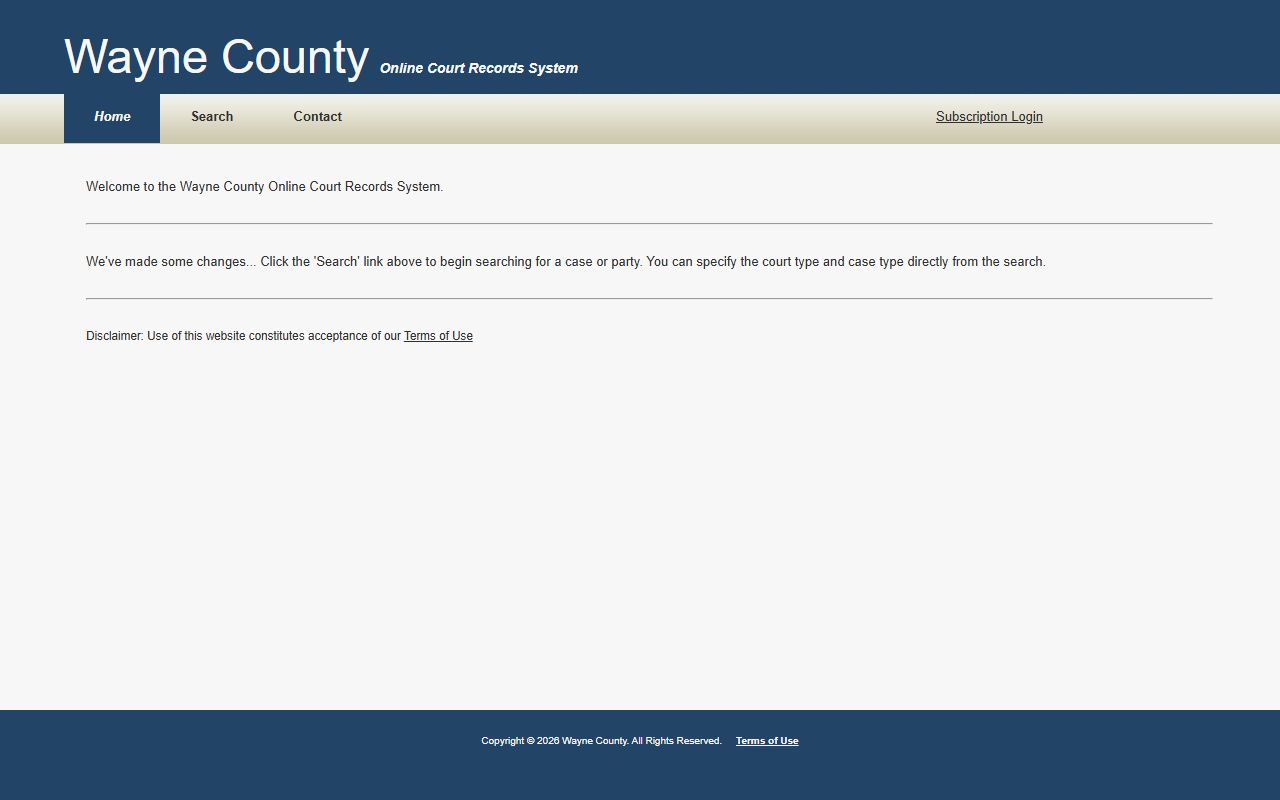
Access Wayne County state court records at https://wayne.tncrtinfo.com/. Some records are free to view. Others may need a login or a small fee depending on the case type and how far back you search.
PACER and Online Case Access
PACER stands for Public Access to Court Electronic Records. It is the main federal tool for finding bankruptcy filings. To use it, you need a free account. Most records cost 10 cents per page, but the total charge per document is capped at $3.00. Many users find that a modest search costs less than a dollar in total fees.
Once logged in, go to the Middle District of Tennessee court through PACER and search by name, case number, or Social Security Number if you have it. Results show the case type, date filed, current status, and all documents on the docket. You can pull schedules of assets and debts, the petition, and any discharge order.
PACER is available at https://pacer.uscourts.gov. There is also a free tool called the PACER Case Locator at https://pcl.uscourts.gov. The Case Locator searches across all federal courts at once and is good if you don't know which district handled a filing.
Quarterly fee waivers apply if your total PACER charges are under $30 in a given quarter. That means most individual researchers pay nothing at all.
What Bankruptcy Records Contain
A complete bankruptcy file holds a lot of detail. The petition lists the debtor's name, address, Social Security Number (partially redacted), and the chapter being filed under. Attached schedules break down all assets, all debts, monthly income, and monthly expenses. Creditors are listed by name and amount owed.
The Statement of Financial Affairs covers recent financial transactions, lawsuits, property transfers, and payments made to creditors before the filing date. In Chapter 13 cases, a repayment plan lays out exactly how much the debtor will pay each month and which creditors get paid first.
Discharge orders, if issued, confirm that the debts covered by the case were legally wiped out. Dismissal orders show if the case was closed without a discharge. Both types of orders are public and appear on PACER. Trustee reports and any objections filed by creditors are also part of the public record.
Under 11 U.S.C. Section 107, bankruptcy records are public by default. Courts can restrict access to specific sensitive information like full Social Security Numbers, but the bulk of each file remains open to anyone who looks it up on PACER.
VCIS Phone Lookup
The Voice Case Information System, or VCIS, lets you check basic case status by phone. No computer is needed. Call 866-222-8029 and then press the extension for the Middle District, which is extension 816.
The system reads back case numbers, filing dates, and whether the case is open or closed. It can confirm if a discharge was entered. VCIS is a good quick check before you spend time on PACER, especially if you just need to know whether a case is still active or has been closed.
The service is available around the clock. Have the debtor's full name ready when you call. The system will match it against Middle District records and give you a summary without any fee.
Filing Fees and Costs
Federal filing fees apply to all bankruptcy petitions. As of now, a Chapter 7 petition costs $338. Chapter 13 costs $313. Chapter 11 carries a $1,717 fee. These fees are set by the federal court and are the same across all Tennessee districts.
Filers who cannot afford the Chapter 7 fee can apply to pay in installments or ask the court to waive the fee entirely. Fee waiver eligibility depends on income relative to the federal poverty guidelines. The court has a standard form for this request, and it must be filed along with the petition.
Attorneys charge separately for their services, and those costs vary widely. Some Chapter 7 cases can be handled for a few hundred dollars in attorney fees. Chapter 13 cases typically cost more because the attorney must stay active throughout the repayment plan, which can run three to five years.
Archived and Historical Records
Old bankruptcy cases that have been closed and removed from PACER may still be available through the National Archives. The NARA facility that holds Tennessee federal records covers cases going back many decades. Some records are available digitally; others must be requested as physical copies.
Visit the NARA court records page at https://www.archives.gov/research/court-records to start a request. You will need basic case information like the case number, the approximate filing year, and the debtor's name. Processing times vary, and some older records require a trip to the physical facility or a paid copy request.
Nearby Counties
Wayne County shares borders with several other Tennessee counties, all of which also fall under Middle District jurisdiction for bankruptcy purposes.