
Search White County Bankruptcy Records
White County bankruptcy cases are filed with the U.S. Bankruptcy Court for the Middle District of Tennessee. The county seat is Sparta, and all federal bankruptcy petitions for White County residents go through the Nashville division of the Middle District court. Cases are public record once filed, and anyone can look them up through the PACER system.
White County Bankruptcy Quick Facts
Middle District Court Coverage
White County is part of the U.S. Bankruptcy Court for the Middle District of Tennessee. That district covers the central band of the state. The Nashville courthouse at 701 Broadway, Room 170, Nashville, TN 37203, is where cases for White County are filed and heard. The clerk's office is reachable at (615) 736-5584.
The Middle District handles all three main bankruptcy chapter types. Chapter 7 is a liquidation case where a trustee reviews assets and may sell non-exempt property to pay creditors. Chapter 13 lets a debtor keep assets in exchange for a three-to-five year repayment plan. Chapter 11 is for business reorganizations and individuals with very high debt loads. All three are available to White County residents.
The court's official site at https://www.tnmb.uscourts.gov has local rules, self-help resources, and instructions for pro se filers. The site also lists emergency filing procedures and court closure notices.
White County Government Portal
The White County government maintains an online presence for local county services and offices. Since bankruptcy is a federal matter, the county itself plays no role in managing those filings. Still, the county website can help you find courthouse addresses in Sparta, contact details for the county clerk, and links to state court resources that handle civil cases.
The White County government portal is particularly useful if you need to look up the status of a civil judgment that may have preceded a bankruptcy filing. Creditors who sued a debtor in state court before the bankruptcy was filed would have a record in White County's state courts, which are separate from the federal system.
The screenshot below shows the White County government portal.

Visit https://www.whitecountytn.gov/ for county office contacts, hours, and general public services. Staff can help direct you to the right state or federal resource when needed.
Tennessee Court Info System Access
The Tennessee Court Information System, tncrtinfo, covers state-level court activity across all counties. White County's portion of the system lets you search for civil filings, general sessions cases, and judgments that were entered in Sparta or elsewhere in White County's state courts.
People who study bankruptcy cases often check tncrtinfo alongside PACER. A creditor might have filed suit in White County Circuit Court before the debtor chose to file for bankruptcy. That state court action stays in the tncrtinfo database even after a federal bankruptcy case is opened. Comparing both databases gives you a fuller picture of the debtor's legal situation over time.
The screenshot below shows the White County section of tncrtinfo.
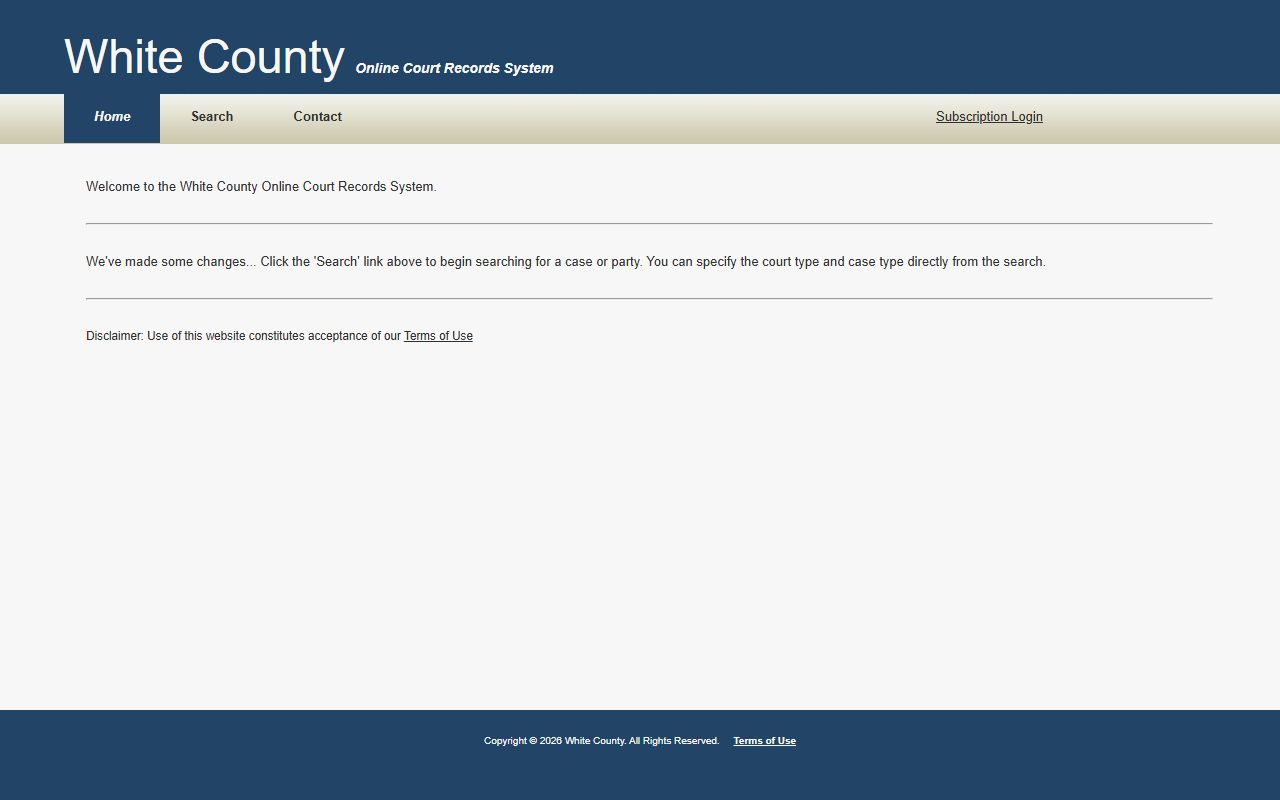
Search state court records for White County at https://white.tncrtinfo.com/. Some searches are free; more detailed data may require a login or small fee.
How to Search Records on PACER
PACER is the federal government's online system for court records. It covers bankruptcy courts, district courts, and courts of appeal across the country. You need a free account to search. Register at https://pacer.uscourts.gov.
After logging in, select the Middle District of Tennessee bankruptcy court and use the party search to look up a debtor by name. The results will show all matching cases, including the chapter type, date filed, and current open or closed status. Click any case to see the full docket sheet, which lists every document filed in order by date.
Each page of a document costs 10 cents to view, with a $3.00 cap per document. That makes even detailed research affordable. A full petition with schedules might run a few dollars total. If your total quarterly charges stay under $30, PACER waives them for that quarter.
The PACER Case Locator at https://pcl.uscourts.gov is a separate, free tool that searches all federal courts at once. Use it if you don't know which district filed the case. It returns a list of courts where a matching case was found, and you can then go into each one on PACER for the full file.
Contents of a Bankruptcy Filing
A full bankruptcy file starts with the petition. That document names the debtor, gives their address, and identifies the chapter type. A partial Social Security Number appears on the petition. Full numbers are redacted from public records under court rules.
The attached schedules are where you find the real detail. Schedule A and B cover real estate and personal property. Schedule C lists exemptions the debtor is claiming. Schedules D, E, and F break down secured debts, priority debts like taxes and child support, and general unsecured debts like credit cards. Creditor names and amounts appear in full on these schedules.
Schedules I and J show monthly income from all sources and monthly expenses. The Statement of Financial Affairs adds context, covering income for the past two years, any lawsuits filed against or by the debtor, property transfers in the prior four years, and payments to creditors in the months before filing.
Federal law at 11 U.S.C. Section 107 makes all of this public by default. Courts can seal specific items only under narrow exceptions. Most files stay fully open on PACER.
VCIS Phone System
The Voice Case Information System lets you check bankruptcy case status by phone at no charge. Dial 866-222-8029 and press extension 816 for the Middle District of Tennessee. The automated system will ask for the debtor's name and then read back case numbers, filing dates, and current status.
VCIS is fast. You don't need a PACER account or internet access to use it. The system runs 24 hours a day, seven days a week. It won't show you the documents, but it confirms whether a case exists and whether it is still active. That can save time before you log into PACER for deeper research.
Fees, Waivers, and Cost Basics
Current federal bankruptcy filing fees are $338 for Chapter 7, $313 for Chapter 13, and $1,717 for Chapter 11. The fee is the same in all three Tennessee districts. You pay it when you submit the petition.
If you can't afford the Chapter 7 fee, you can ask the court to waive it. The court looks at your income against the federal poverty level. If you earn less than 150 percent of the poverty threshold, you may qualify for a full waiver. The form for the waiver request must go in with the petition. There is no waiver option for Chapter 13.
Attorney fees are separate and vary a lot. Simple Chapter 7 cases with few assets often cost less than $1,500 in total legal fees. Chapter 13 cases take longer and cost more, sometimes running $3,000 to $5,000 or more over the life of the plan. Some filers in White County choose to file without an attorney, called filing pro se. The court's website has self-help materials to assist those filers.
Archived Records at NARA
Cases that were closed long ago may have moved off PACER. The National Archives and Records Administration keeps older federal court records, including closed bankruptcy files from Tennessee. You can start a search at https://www.archives.gov/research/court-records.
Have the debtor's name and approximate filing year ready. A case number speeds up the search. NARA may have digital copies of some older records. Others may need a formal written request, and fees can apply depending on the volume of documents you need. Processing can take weeks or longer for older cases.
Nearby Counties
White County shares borders with several other Middle District counties. All of them use the Nashville courthouse for federal bankruptcy filings.